
Find Out Who Owns an Elkhart County Property
An address is only the first step in Elkhart County, not the answer itself. Start with the free assessor and GIS search. That yields the tax-roll owner and the parcel number. The newest vesting deed then does the confirming. It names the grantee and locks in the legal description, while Auditor transfer data explains the timing between owners. When the named owner is an Indiana entity, INBiz can identify its registered agent.
- Search the address through the Elkhart County Assessor GIS page and select the matching parcel.
- Copy the full parcel number, including its leading 20, and read the owner and mailing fields on the property record card.
- Search the newest recorded conveyance through the Elkhart County Recorder; compare its grantee and legal description with the parcel.
- If an LLC is named, check the entity and registered agent in the Indiana INBiz public business search. Do not assume an agent is the property's beneficial owner.
Every step of this route has a custodian. That beats an address-only directory. The current property owner guide digs into present-owner detail, while the former owners record trail traces earlier transfers.
The Elkhart Property Card Supplies the First Name
The Assessor's published property-record-card guide confirms three free search modes: Owner, Address, and Parcel Number. The parcel-number search needs the leading 20. An address result can link a situs address to an owner name, an owner mailing address, a parcel identifier, and assessed characteristics. Treat the owner line with care. It is an administrative roll entry, so keep the parcel number and retrieval date beside the name.
Tax notices go wherever the owner directs. So the mailing address may sit far away. It is not proof of occupancy. A city name inside that address does not establish municipal jurisdiction, and when an owner search returns several same-name records, compare the parcel, situs, mailing details, and newest deed instead of trusting the name alone.
The platform has migrated over time. The Assessor's GIS information page documents the current search launch and its migration context:
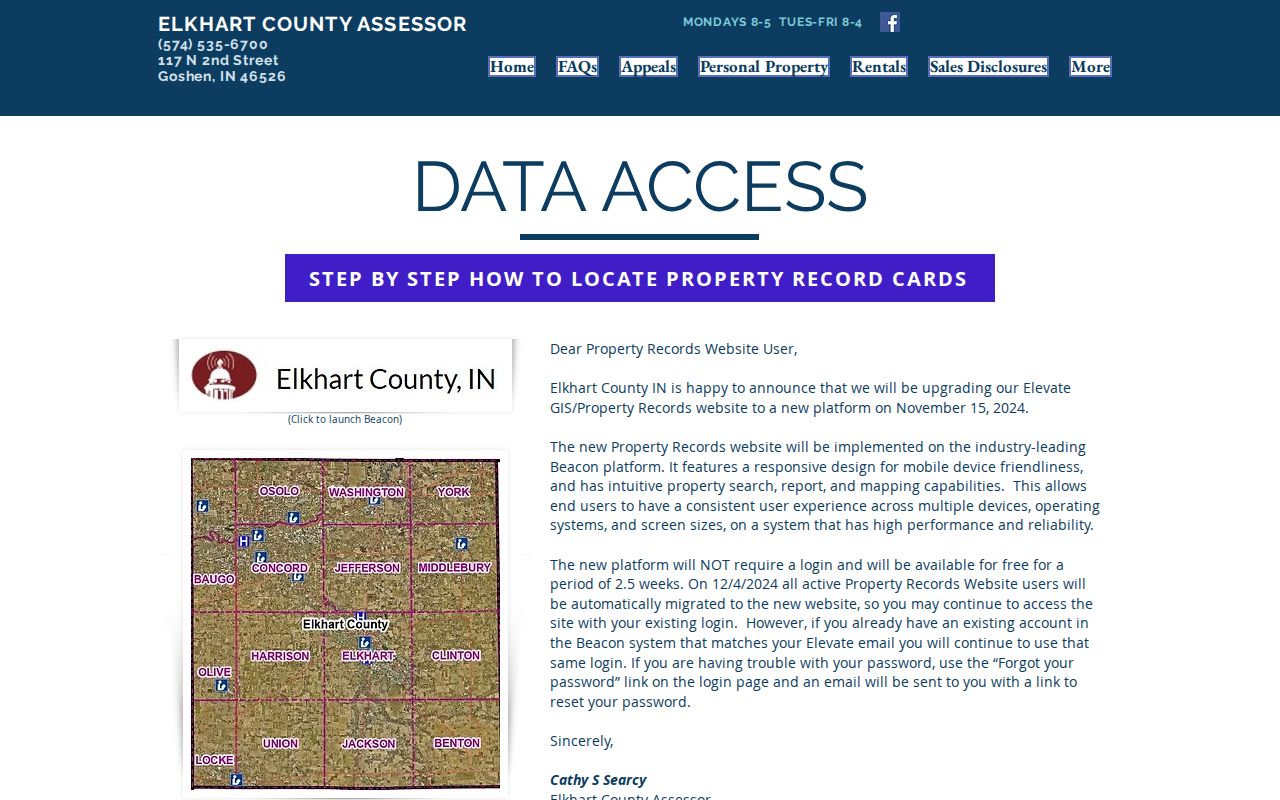
Use that official entry point to reach the county-supported platform. Then carry its parcel number straight into the ownership-confirmation step that follows.
Where Elkhart County Records Show Ownership
No one screen answers everything. The assessor roll offers the fastest current clue, while the Recorder's index and document supply the recorded confirmation. GIS ties the inquiry to map geography. The Auditor keeps transfers for the tax rolls, and its dates can lag behind a closing, so a gap between offices is normal rather than alarming.
| Source | Owner Info It Gives | Access |
|---|---|---|
| Assessor property card | Tax-roll owner, owner mailing address, situs and parcel number | Free county-linked GIS/property search |
| Recorder deed record | Grantee, instrument date, recording reference and legal description | Tapestry fee route, Laredo subscription, or office public computer |
| Auditor transfer roll | Ownership transfer used for tax administration | Auditor office |
| GIS parcel viewer | Mapped parcel context linked to the administrative record | County GIS page and current Beacon/Elevate route |
The owner of record may not be the occupant. Occupants, permit applicants, property managers, and registered agents each hold a different relationship to the land. The label matters. For purchase due diligence or an estate question, pin down the record and date behind the name before turning a contact clue into a title conclusion.
Confirm the Name in the Elkhart Recorder's Chain
The Recorder keeps every instrument that affects real estate: deeds, mortgages, assignments, releases, affidavits, liens, plats, contracts, and federal tax liens. Two online doors exist. Tapestry EON offers fee-based access, while Laredo serves subscribers. The Recorder publishes no earliest online-index year. So a name missing from the web is not missing from the land records.
Without recording information, visit the public computers at 117 North 2nd Street in Goshen. Staff will not run the search. They can provide a copy once the recording reference is known. Then check the latest deed's grantee, legal description, and prior reference against the assessor parcel. Timing can trick you. A freshly recorded deed may outrun the owner still carried on an assessment roll awaiting transfer processing.
- Owner of record
- The person or entity named on the current administrative ownership roll.
- Grantee
- The party receiving an interest in the recorded conveyance.
- Vesting deed
- The recorded instrument by which the current named owner took title.
- Situs and mailing address
- The property location and the separate destination for owner correspondence.
LLCs, Trusts, and Estates Change the Answer
When an LLC holds the deed, the company is the grantee, not its registered agent. INBiz helps here. It can show the entity's name, status, type, addresses, registered agent, and governing-person information. All of it comes from the filing record. Those fields are leads. They are not proof, so search spelling variants. Then compare filing dates with the deed and the Auditor transfer.
Trusts are slippery. A trust may appear under the trust name, the trustee's name, or both. Estates add another layer. A probate court may stand between the death and the deed. A personal representative may stand there too. The deed finally reaches the Recorder through them. When the trail runs through court, search public nonconfidential docket information on Indiana MyCase. Then request the official filing from the Elkhart County Clerk. Never infer a transfer from a docket caption alone.
Note: A registered agent is a contact for an entity; that role does not by itself establish personal ownership.
Elkhart's Fraud Alert Watches Recorded Names
The Recorder advertises a free service called the Elkhart County Property Fraud Alert. It watches recorded names. A subscriber can be notified when a document is recorded under a monitored name. The alert does not block a filing. Nor does it judge fraud. It also cannot continuously certify who owns a property. What it gives is speed: a prompt to inspect the recording and contact the Recorder or the right professional quickly.
The service fits neatly into the owner-finding method. The assessor supplies the working owner line, the newest deed supplies recorded evidence, and the alert watches later name-index activity. That monitoring matters because ownership records sit scattered across agencies rather than in one title database.
What an Elkhart Ownership Lookup Cannot Prove
An Elkhart County ownership lookup has real limits. The tax roll can name the owner of record. A recorded deed shows the grantee. What public property records cannot show is who actually lives there. Nor can they surface every unrecorded interest. They cannot settle conflicting claims or stand in for a full title examination. Remember, too, that mailing addresses sometimes differ from the situs on purpose. Indiana's Address Confidentiality Program shields certain sensitive records and addresses.
Ownership clue, not title proof. An Elkhart County owner name may be delayed, incomplete, or held through an LLC or trust. Verify the newest recorded deed and use public information only for lawful property research - never stalking, harassment, or harm.
Commercial data tools aggregate names and parcel addresses at scale. They are not the official custodians, though. Records merged from multiple sources can mix two people together or carry an owner of record who changed years ago. For an answer to "who owns this property" that anyone can reproduce, cite the county parcel, the assessment-card retrieval date, and the Recorder instrument behind the name.
Use the Elkhart Auditor to Resolve Timing
The Elkhart County Auditor keeps ownership transfers current for tax rolls, calculates taxes and special assessments, and audits deductions. That job makes the office a natural tiebreaker. It helps most when the assessor's owner and the newest deed seem out of sequence. Ask about the transfer posted for one specific parcel rather than a broad ownership investigation. The Auditor sits at 117 North 2nd Street, Room 203, Goshen, at 574-535-6719. One transaction can carry three dates. Execution, recording, and administrative transfer need not match. Keep each date separate and note its source. That discipline explains why a deed names a new grantee while an older owner still lingers on a property card. It does so without promising an update interval Elkhart County has never published.
City Permit Files Add an Applicant Timeline
Inside municipal limits, permit and zoning files can name an owner, an applicant, a contractor, an inspection, or a certificate-of-occupancy event. Those roles add useful context. They never supersede the deed. Verify jurisdiction first, because a postal city name does not establish city limits. For the municipal layer you need, use Elkhart property records, Goshen records, or Nappanee property records. A permit applicant may have been the owner, an agent, or a contractor on the application date. State that exact role plainly. Converting it into current ownership would overstate the record. Near a city edge, compare the county GIS municipality layer, the city's planning map, and any dated annexation record before picking a permit custodian. That quick geography check keeps a mailing-city label from steering an ownership inquiry to the wrong municipal office.