
Elkhart Deed Records by Type
The Elkhart County Recorder keeps real-estate instruments forever. Deeds sit beside mortgages, assignments, releases, affidavits, liens, contracts, federal tax liens, and plats in the same permanent archive. Read each instrument's type, parties, and legal description together, because every document does different legal work.
| Deed Type | What It Does | Common Use |
|---|---|---|
| Warranty deed | Conveys the stated interest with deed covenants | A conventional sale |
| Quitclaim deed | Conveys whatever interest the grantor holds | Family transfer or cleanup |
| Trustee deed | Documents a transfer by a trustee | Trust administration |
| Personal representative deed | Transfers under estate authority | Probate administration |
| Tax deed | Follows the completed statutory sale process | Delinquent-tax transfer |
A deed conveys a stated interest. It does not prove occupancy. Mortgages, liens, and easements can burden that interest, while a release changes its later standing, and unrecorded claims may never appear on the face of the document.
Three Elkhart Recorder Routes
Paid document access runs through Tapestry EON, while Laredo covers subscribers who search often. No recording reference is needed for either. Public computers at the Recorder's Goshen office support a self-directed search when the reference is unknown. Staff will not perform the search itself. Identify the document and staff supply a copy. A phone call confirms rules, hours, and fees, and mailed requests go in with a self-addressed stamped envelope. APRA reaches retained, nonexempt index and copy material. State Library collections, microfilm, FamilySearch catalog entries, IARA, and local archives serve as historical fallbacks, so a failed portal query never ends the deed search.
Elkhart's Tapestry Doorway
The successful Tapestry capture below shows the county's online recorded-document route.
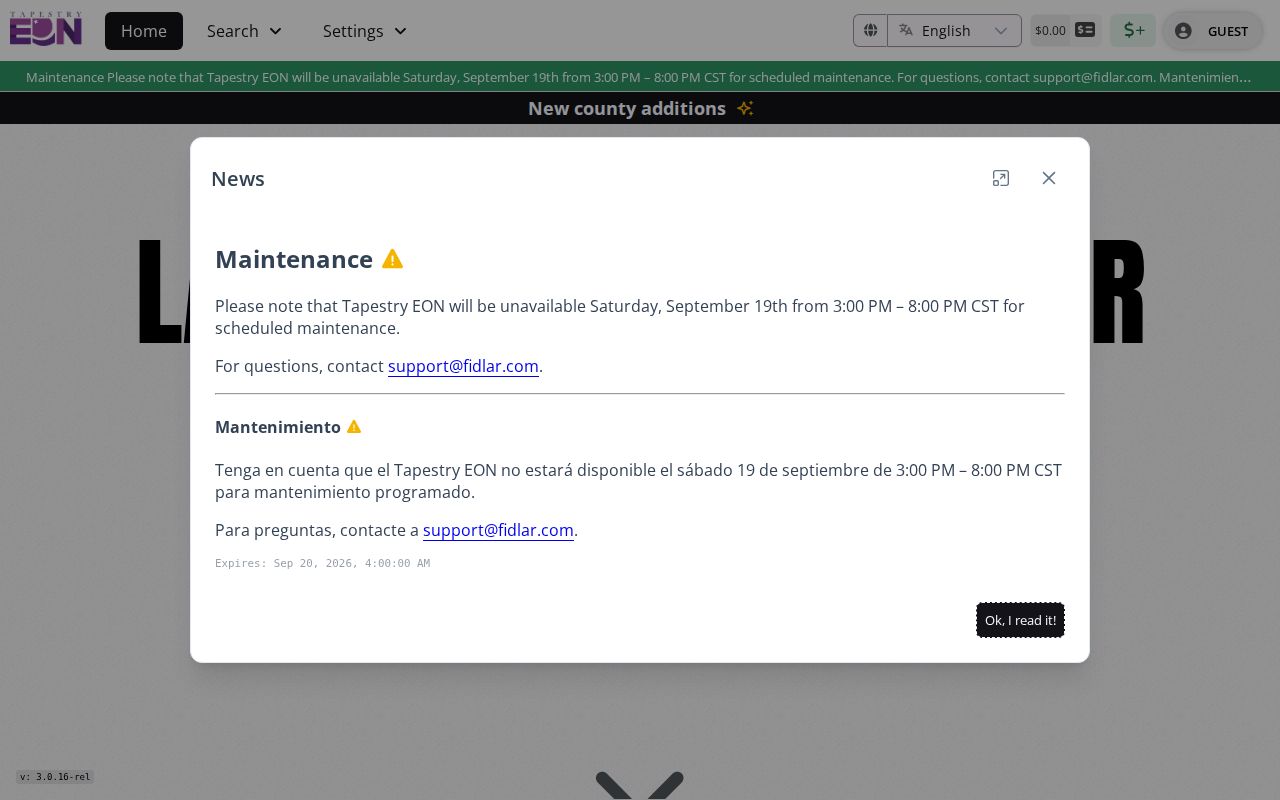
The official material does not state the earliest year available online. Treat Tapestry as one doorway, not proof that every Elkhart County deed record sits on the web.
| Index clue | Purpose | Check |
|---|---|---|
| Grantor or grantee | Finds transfers by party | Variants, initials, trusts, entities |
| Type and date | Narrows deeds, liens, or releases | Current live labels |
| Book/page or instrument | Retrieves one filing | Image and copy access |
| Legal description | Bridges APN changes | Lot, block, or township text |
Elkhart's Grantor-Grantee Chain
The grantor conveys the stated interest. The grantee receives it. To find an acquisition deed, search the current tax roll owner as a grantee, then use that deed's grantor and prior reference to walk the chain backward. Search each party as a grantor too, since that angle can surface a later deed, release, or related instrument.
- Collect the Assessor roll name, full parcel number, and legal description.
- Find that party as grantee and identify the deed that vested the stated interest.
- Record the grantor, date, type, reference, and any cited prior deed.
- Repeat with name variants, then move to deed books or microfilm when digital results stop.
- Grantor
- The party conveying the stated interest.
- Grantee
- The party receiving the stated interest.
- Chain of title
- The linked sequence of recorded interests for the same land.
- Book/page or instrument
- The Recorder's reference for one filed document.
Elkhart Deed Books Since 1830
Elkhart County dates to 1830, and State Library records and microfilm carry deed-book material from that founding year forward. Indexes sort the entries by alphabet and year. Old volumes lack modern parcel numbers. The bridge is the legal description: prior-deed citation, township, subdivision, lot, and block. The Surveyor's scans of sixteen original township plats and State Library map holdings add geographic context. No courthouse fire marks the county's history. A missing digital result is not a lost record. The real gap is an unpublished online cutoff rather than any destruction of records.
Elkhart Recording and Copy Fees
Indiana's recorder schedule, effective July 1, 2017, sets deeds at $25, mortgages at $55, copies up to 11 by 17 inches at $1 per page, larger copies at $5, and certification at $5. Verify fees before ordering. State fees cannot be waived. Mail filings need a self-addressed stamped envelope, and originals return after archival processing. The office provides no blank legal forms or legal advice. Blanket assignments and releases are not accepted. Checks follow the county's published payment instructions.
Elkhart Property Fraud Alerts
The Recorder offers free enrollment in Property Fraud Alert. A subscriber gets notice when a document is recorded against a monitored name or property. That notice starts the clock. The service helps an owner react, but it blocks no filing, insures no title, and proves no validity. Compare any alert against the official Recorder index. Use the county's published contact number, never a phone number from an unsolicited deed-copy letter, since private solicitations may charge far more than the public copy fee.
Releases Complete Elkhart Chains
A deed chain reads best with its burdens attached. A recorded mortgage does not vanish on its own. Search the borrower and lender names. That angle surfaces assignments, modifications, and eventually a satisfaction or release. For an easement, compare the creating document against any later vacation, amendment, replat, or court order.
A lien index hit proves nothing about current enforceability. Record the claimant, debtor, instrument type, date, legal description, and any later release or satisfaction. Check both party names and the land description. A parcel split can hide older filings. Priority, expiration, and legal effect may call for professional title review, since the Recorder supplies the public instrument, not an opinion about what wins.
Plats form another link in the Elkhart record chain. Capture the subdivision name, lot and block, plat book or instrument reference, surveyor, dedications, easements, and replat citations. County Planning packets and the Surveyor's township scans can explain the land pattern, but the recorded plat remains the key filed source.
Name searches in Elkhart County deserve care. Try married and maiden surnames, initials, spelling variants, spouse names, and corporate suffixes. Same-name parties are common. Township, legal description, parcel, spouse, and recording references tell them apart, so never merge two chains only because the names look alike.
Order an Elkhart Deed Copy
A digital image works well for everyday research. Order a certified copy when you need official authentication instead. Give the office the book and page or instrument number, the record type, the parties, and the recording date. Search online or at the public computer first if you lack those details. Keep the citation with your copy so another researcher can retrace the same step in the deed chain.
The Recorder sits at 117 North 2nd Street in Goshen, reachable at 574-535-6756. Monday hours differ from the Tuesday through Friday schedule, so confirm before you go. Restricted records are handled on a separate track. Military discharges recorded after May 15, 2007 fall under IC 10-17-2-4, which makes them confidential and open only to authorized requesters.
Recorded, not guaranteed. Elkhart County deed records show filed instruments, not a title opinion; unrecorded interests and unresolved priority questions may remain.