
Trace Elkhart County Former Owners by Era
Timing shapes the route. Recent transfers start with the current parcel card and the latest recorded deed. Older work moves through the Recorder's index into microfilm, deed books, and historic plats. Elkhart County was created in 1830. Surviving deed records reach back toward that beginning. The county does not publish the earliest year available in its online paid index.
| Source | Years It Covers | Where Held | What It Shows |
|---|---|---|---|
| Recorder index and deed images | Current range; first online year not published | Tapestry EON, Laredo, or Recorder public computer | Grantor, grantee, instrument, recording date, and legal description |
| Deed indexes and volumes on microfilm | 1830-1902 | Indiana State Library and county research routes | Earlier buyers, sellers, book/page citations, and transfers |
| FamilySearch deed catalog | 1830-1915 | FamilySearch catalog access | Digitized or cataloged deed books and indexes, subject to access controls |
| Township and recorded plats | Historic through current | County Surveyor, Recorder, and Planning | Subdivision, lot, block, easement, and replat context |
Always begin in the newest source that names the same legal parcel. When the online trail ends, keep the last dependable grantor name and its book and page. Those details bridge you into the older index. Searching by modern address alone gets fragile fast.
Elkhart County's Unpublished Online Deed Cutoff
Tapestry EON sells digital access to recorded documents, and Laredo serves subscription users. Neither the official Recorder page nor the Tapestry landing page states the earliest indexed year. That gap matters for tracing previous owners. An empty result may simply mean the deed predates online coverage. It does not mean no transfer ever occurred.
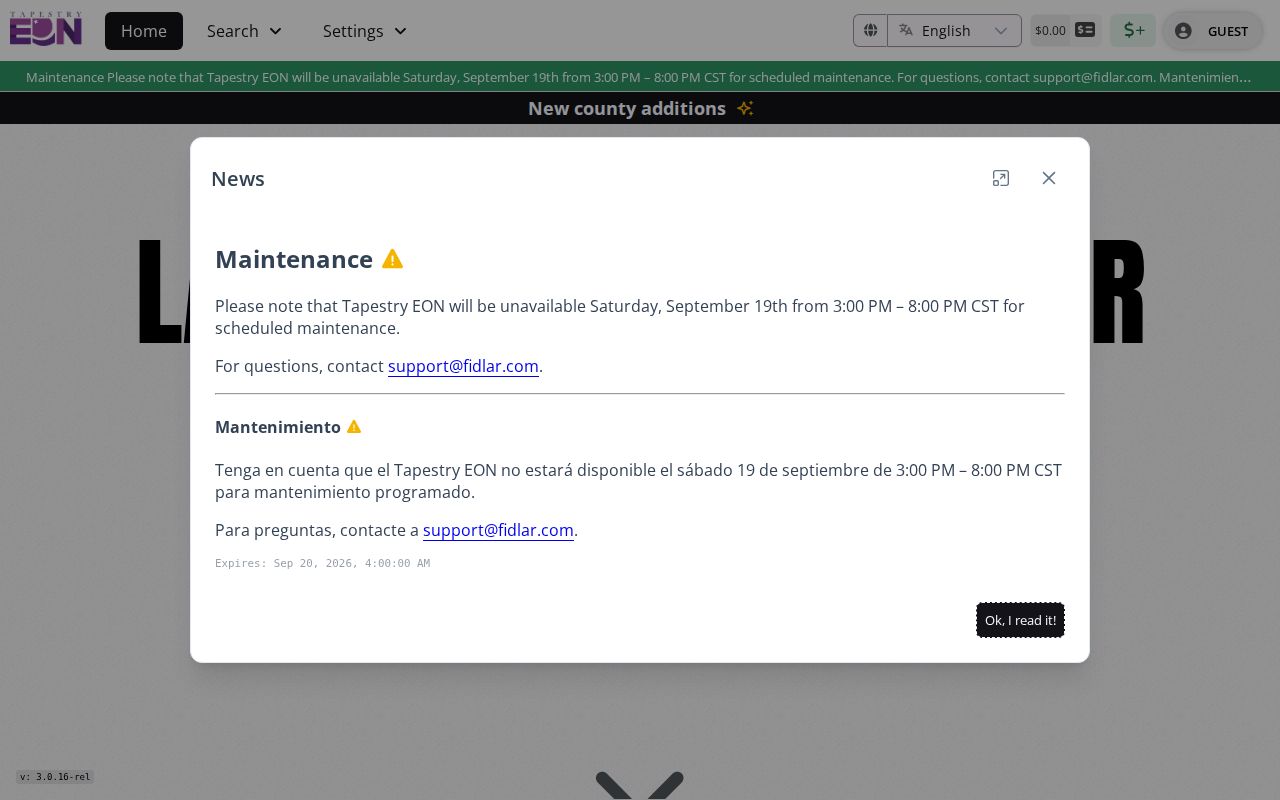
The Tapestry landing page lays out the digital access route. For chains older than the web results, the Recorder's public computers and historical volumes remain the working fallbacks.
Coverage check. Ask the Recorder which years and document images are online before treating a name search as complete.
When recording details are unknown, the Recorder's public computers are the practical next stop. Once a book, page, or instrument number turns up, staff will supply a copy. They will not run the chain search for a requester, though.
Elkhart County Former Owners on 1830-1902 Microfilm
The Indiana State Library's Elkhart County microfilm list names the deed-index and deed-volume reels. The reels cover 1830 through 1902. That stretch is the core time-depth tool when old books carry no modern parcel numbers. It also reaches the county's founding era.
Work the grantee index for the owner who appears as grantor in the newer deed. Note the volume and page, then pull that volume. Repeat with the earlier grantor. A handwritten spelling variant, a spouse, a trust, or a company name may force you to scan nearby index entries rather than trust one exact match.
Walk Elkhart County's Deed Chain Backward
Every deed ties two points in the ownership line together. The buyer is the grantee, and the seller is the grantor. Tracing past owners means reversing the usual forward index logic, using the prior deed citation whenever the document itself supplies one.
- Use the assessor card and latest transfer date to identify the current parcel, then locate the present owner's vesting deed.
- Copy the grantor name, legal description, instrument or book/page, recording date, deed type, and prior-reference line.
- Search that grantor as a grantee to find the deed by which the former owner acquired the same legal parcel.
- Repeat until the online index ends, then continue through the 1830-1902 microfilm, original books, or the 1830-1915 FamilySearch catalog.
- Grantor / grantee
- The conveying party and the receiving party named on a deed.
- Chain of title
- The ordered sequence of recorded transfers affecting the same land.
- Reverse index
- An index arranged to find instruments through the seller or grantor side of a transaction.
- Warranty / quitclaim deed
- Different conveyance forms; neither label alone resolves every title issue.
Record Elkhart County Book and Page Citations
A history others can rebuild needs more than names. For each transfer, capture the instrument number or book and page, the recording date, the deed type, full grantor and grantee names, the legal description, any parcel identifier shown, and the image pages consulted. With that citation, another researcher can return to the same deed even after a search interface changes.
| Transfer date | Grantor to grantee | Deed type | Book/page or instrument |
|---|---|---|---|
| Enter recording date | Copy names exactly as indexed | Warranty, quitclaim, trustee, or other | Preserve the official locator |
| Earlier transfer | Prior grantor to later grantor | Use the document label | Follow any prior deed reference |
Built this way, the timeline exposes gaps, conflicting legal descriptions, and unexplained parcel changes. Note: it is a research log, never a title opinion.
Elkhart County Plats Explain Changed Parcels
A chain of former owners can appear to vanish. That happens when land was split, combined, replatted, or described by lot and block rather than street address. The County Surveyor's scans hold original plats for all 16 townships. Recorder plats and Planning subdivision packets add subdivision names, lot and block numbers, dedications, easements, filing dates, and replat references.
Match the deed's legal description against the plat, not just the parcel outline shown today. One plat can reveal that a modern tract assembled several older lots. Or it can show that a single former tract became several current parcels. That explains why prior owners differ across portions.
Search Elkhart County Previous Owners Under Variants
Names drift across generations of records. Index entries may use initials, a spouse, a former surname, a trust, an estate, or a corporate owner. Search both sides of the transaction while holding the legal description constant. For an estate transfer, MyCase or the official Clerk file may explain the authority. But the recorded deed remains the land-record link.
Never assume two people sharing a name are one owner. Mailing addresses, marital or vesting language, dates, and a matched parcel description keep them apart. The Auditor's transfer record can also align a tax-roll change with the Recorder's filing date.
Elkhart County's Free Recording Alert
The Recorder offers free Property Fraud Alert registration. The service sends notice when a document is recorded against a monitored name or property. It earns its keep once a house-history project has surfaced the exact owner-name variants worth watching.
Remember that the service only alerts. It proves no title. It blocks no filing and replaces no title insurance. Nor can it guarantee notice of every suspect instrument. Investigate any notice through the Recorder and compare it against the deed chain already established.
How Far Elkhart County Ownership Records Reach
Tracing past owners in Elkhart County can reach back to the county's founding in 1830. The State Library holds deed records on microfilm covering 1830 through 1902. FamilySearch extends that deed catalog through 1915. Older or harder-to-find material lives elsewhere. Original county books and the Indiana State Archives cover research needs beyond any web index. Surveyor plats and local historical collections help as well.
The Recorder's office welcomes in-person research into its deed records. Written copy requests should name the instrument and include a self-addressed stamped envelope. If a nonexempt record sits outside routine access, a narrow Indiana Access to Public Records Act request works best. Identify the parcel, the document type, and the date range. Keep in mind the agency performs no research and builds no ownership chain for you. The deed records themselves do that work.
Lawful use. Research former owners for house history, estate work, or property diligence; never use public records to target or harass a living person.