
Compare Elkhart County Property Value Types
One parcel can hold several legitimate figures. Each exists for a different purpose. Indiana assesses real property at 100 percent of market value-in-use. That concept differs from a buyer's offer, one deed's consideration, or a private appraisal.
| Value | What It Is | Where |
|---|---|---|
| Assessed value | Indiana market value-in-use used for tax administration | Assessor card and DLGF data |
| Market estimate | A date-specific opinion from an appraisal or market analysis | Independent professional work |
| Last sale price | Consideration from one transfer, subject to its terms | Sales disclosure and deed data where displayed |
| Land and improvements | Components that form total assessed value | Assessor property card |
Always compare like years and like parcels. A sale may bundle several tracts or carry unusual terms, while an assessment follows mass-appraisal rules instead. A new addition can shift improvement value sharply and leave the land component untouched.
Read Elkhart County Land and Improvement Values
The Assessor describes a property record card as a detailed record of measurable items. Expect parcel number, address, legal description, land area, land value, improvement value, total assessed value, class, neighborhood code, tax district, age, condition, living area, outbuildings, and sketch pages. Field order on the live portal may vary. Go by field names rather than layout. Physical facts carry weight here. Exterior measures round to the nearest whole foot, and structures count as improvements. Quality and condition indicators often appear too. They explain the model, but they are no substitute for a private inspection or appraisal.
Elkhart County Reviews About One Quarter Each Year
The Assessor's reassessment page cites IC 6-1.1-4-4 and reports that cyclical review covers roughly 25 percent of parcels each year. A printed or online questionnaire can document property characteristics. Keep four things distinct: the inspection year, any physical change, the sale review, and the final assessed value. Neighboring parcels may have different review dates. A jump can reflect new facts about a structure rather than one flat countywide increase. Check the assessment year before comparing property values.
Look Up an Elkhart County Assessed Value
The county guide offers three free entry modes: Owner, Address, and Parcel Number. Each result routes to a property card rather than a full appraisal file. Preserve the year and parcel ID with every number you copy.
- Open the Assessor GIS information page and follow its current Beacon/Elevate link.
- Choose Address or Parcel Number, use autocomplete, and include the leading 20 for parcel searches.
- Select the result, choose View Map, and click the parcel number under Property Record Card to open the PDF.
- Record land, improvement, and total assessed values with the year; treat sale data as a separate reference.
- Assessed value
- The market value-in-use figure on the Indiana assessment record.
- Market value
- A probable exchange value as of a stated date, often requiring a separate appraisal.
- Assessment ratio
- The relation between assessed and market measures; Indiana uses a 100 percent standard.
- Reassessment
- The cyclical review of parcel traits and valuation.
Open the Elkhart County Property Value Search Route
The Assessor GIS information page is the official bridge to the property search.
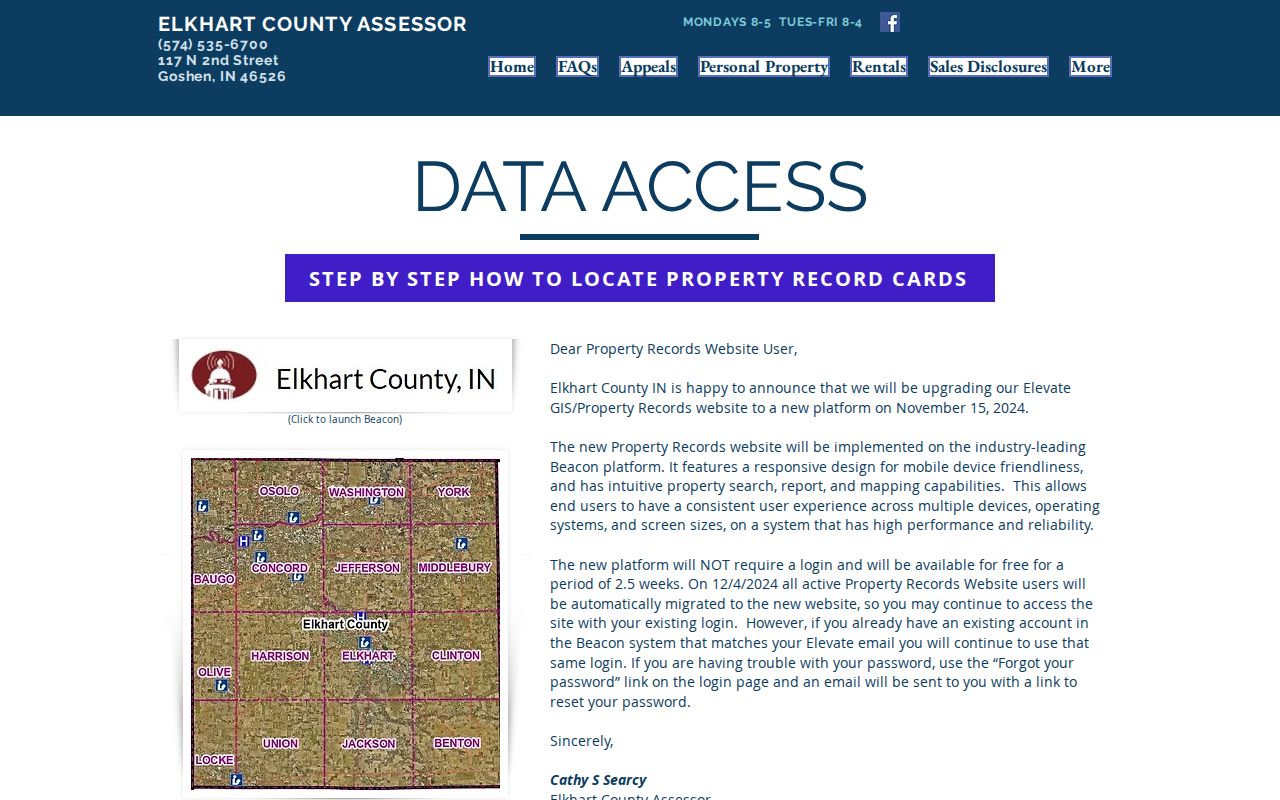
The county's official property search page is where to begin; the parcel card shows each assessed-value component along with its year.
Separate Elkhart County Sale Price From Assessment
A sales disclosure can carry price and validation information used in assessment work. A deed may add consideration clues. Neither proves the figure was an arm's-length market sale for just the parcel in question. Family transfers, bundled parcels, and unusual terms can all weaken the comparison. Sales disclosure forms carry a valid-for-trending flag. Treat it as part of the sales record. Do not treat it as proof that the deal sets every nearby property value. Compare date, legal description, parcel count, and improvements before drawing conclusions.
Elkhart County Assessment Year Is Not Payment Year
Indiana assessment data belongs to an assessment year, while tax based on that value is paid later. Mixing the two creates false jumps. The DLGF assessed-value search lets county data be viewed or downloaded by assessment year. For a trend, keep one row per year and preserve land, improvement, and total values. Tax caps limit tax, not assessed value. Bills, deductions, and appeals belong on the property-tax page.
Use Elkhart County DLGF Ratio Studies Carefully
The Indiana DLGF county page publishes ratio studies, land orders, narratives, budget orders, and approval letters. A ratio study tests performance across groups of parcels. It does not set one home's price. Use it for broad context, and for a single parcel return to its card, year, class, neighborhood code, physical facts, and valid sales disclosures.
Trace Elkhart County Value Changes to Property Facts
Assessed value can move for many reasons. Construction, demolition, or an outbuilding can each play a part. So can revised measurements, changed condition, a parcel split, or new sales information. The card is the starting point. It separates land from improvement components, and it preserves the sketch and measurable traits behind the total. City permit files add another timeline inside municipal limits. A permit, inspection, or certificate can show when work occurred. But it does not state the county's assessment result. Compare its date with the reassessment record instead of assuming one caused the other.
Build an Elkhart County Assessed-Value History
Collect the same fields for every year: parcel number, land value, improvement value, total assessed value, class, neighborhood code. Add any split note. When the current card lacks older years, turn to DLGF downloads and county copies. Tax books, Auditor transfer records, and State Library material are documented fallback channels. Narrow APRA requests are another. Keep the source and retrieval date with each row. A parcel-number change can make one apparent history cover different tracts. Tie the series to the legal description. Flag gaps instead of filling them with estimates. That discipline keeps the property value record distinct from a private price opinion.
What an Elkhart County Property Value Cannot Prove
An assessed value cannot prove what a parcel would fetch in a current sale. It does not prove condition. Nor does it settle title or confirm a boundary. Markets can move after the assessment date. Mass appraisal simply cannot weigh each feature the way a buyer or appraiser might.
Value vs price. Elkhart County assessed value supports taxation; it is not a sale price, offer, or independent appraisal.
A value pulled from Elkhart County property records has real limits. It cannot settle every question. For a date-specific opinion, hire a qualified appraiser; for title instruments, go to the Recorder; for disputed boundary lines, use a surveyor; and for the official assessment record, rely on the Assessor's office.