
Read the Elkhart County Property Tax Record
No single screen holds the whole tax record. The Assessor's property card carries the core fields, the Treasurer's bill shows what is owed, and the Auditor adds transfers, deductions, special assessments, and the tax calculation. Match every layer by parcel or account number and year.
| Field | What It Shows | Where |
|---|---|---|
| Gross assessed value | Land, improvements, and total value before deductions | Assessor property card and tax bill |
| Deductions and net value | Approved reductions and the resulting net assessed value | Auditor records and tax bill |
| Taxing units and charges | Rates, levies, credits, special assessments, and applicable charges | Treasurer bill |
| Installment and payment | Amount due, due date, penalty, prior balance, payment, and receipt | Treasurer and InvoiceCloud |
| Delinquency or sale | Official delinquent balance and tax-sale process status | Treasurer and SRI materials |
Assessed value feeds the tax math. It is not a current sale offer. Gross and net figures can differ because deductions shrink the taxable base, while tax caps lower the tax itself without touching the assessed value.
Three Offices Divide Elkhart County Property Tax Work
Each office owns a different slice. The Elkhart County Assessor keeps property record cards, sales disclosures, assessment notices, reassessment, and appeals. The Auditor works from Room 203 at 117 North 2nd Street. That office records ownership transfers for the tax rolls. It also computes tax and special assessments and audits deductions. The Treasurer sits in Room 201. That office issues bills, takes payments, and manages penalties, delinquencies, copies, and tax sales.
Send questions to the right office. A deed proves the recorded conveyance, and the Auditor posts the tax-roll transfer. The Assessor values the parcel. The Treasurer states what is billed or paid. One office's date does not update every other record the same day.
Elkhart County Property Tax Has Two Main Due Dates
Elkhart County collects in two installments. They fall due May 10 and November 10, or the next business day when a date does not qualify, and the Treasurer mails bills at least 15 business days before the first deadline. Not receiving a bill waives nothing. Confirm the official ledger instead of waiting on mail.
Miss a deadline and the cost climbs. A five percent penalty applies within 30 days after a due date, then another five percent lands on day 31. Partial payments are accepted. Calendars and balances change, so quote the bill's own year and installment rather than carrying an old deadline forward.
Look Up an Elkhart County Property Tax Bill
The county links InvoiceCloud for tax lookup and payment. The parcel number doubles as the account number. No registration is needed to view or pay, though a county property search is the better first stop when only an address is known.
- Find the parcel through the Assessor's free Owner, Address, or Parcel Number search; include the leading 20 for a parcel search.
- Use that parcel as the InvoiceCloud account number and select the correct tax year and installment.
- Compare gross value, deductions, net value, credits, special charges, amount due, and payment status.
- For a mismatch or older history, request a parcel-bounded bill or ledger from the Treasurer and deduction records from the Auditor.
- Assessed value
- The parcel value placed on the assessment record under Indiana market value-in-use rules.
- Levy and tax rate
- The authorized revenue and applied rate used with taxable value in the bill calculation.
- Homestead deduction
- Property-tax relief that must meet current Indiana and county filing rules.
- Tax lien
- The legal claim tied to unpaid property tax; a delinquent balance does not itself prove a completed sale.
Capture Every Elkhart County InvoiceCloud Field
Treat every bill as an inventory. The screens have no fixed field order. List parcel or account number, taxpayer billing name and address, property address, tax year, installment, gross land and improvement value, deductions, net value, taxing units, rates, special assessments, credits, amount due, penalty, prior balance, and payment reference.
Online payments carry service charges. An e-check costs $0.95, and a card payment runs 2.95 percent with a $1 minimum. The county caps online payments at $125,000. Paying by phone at 1-888-881-9911 requires the parcel number, tax type, and tax year. Confirm fees on the payment screen before submitting.
See the Elkhart County Property Tax Payment Entry
The Treasurer links InvoiceCloud as the official payment path.
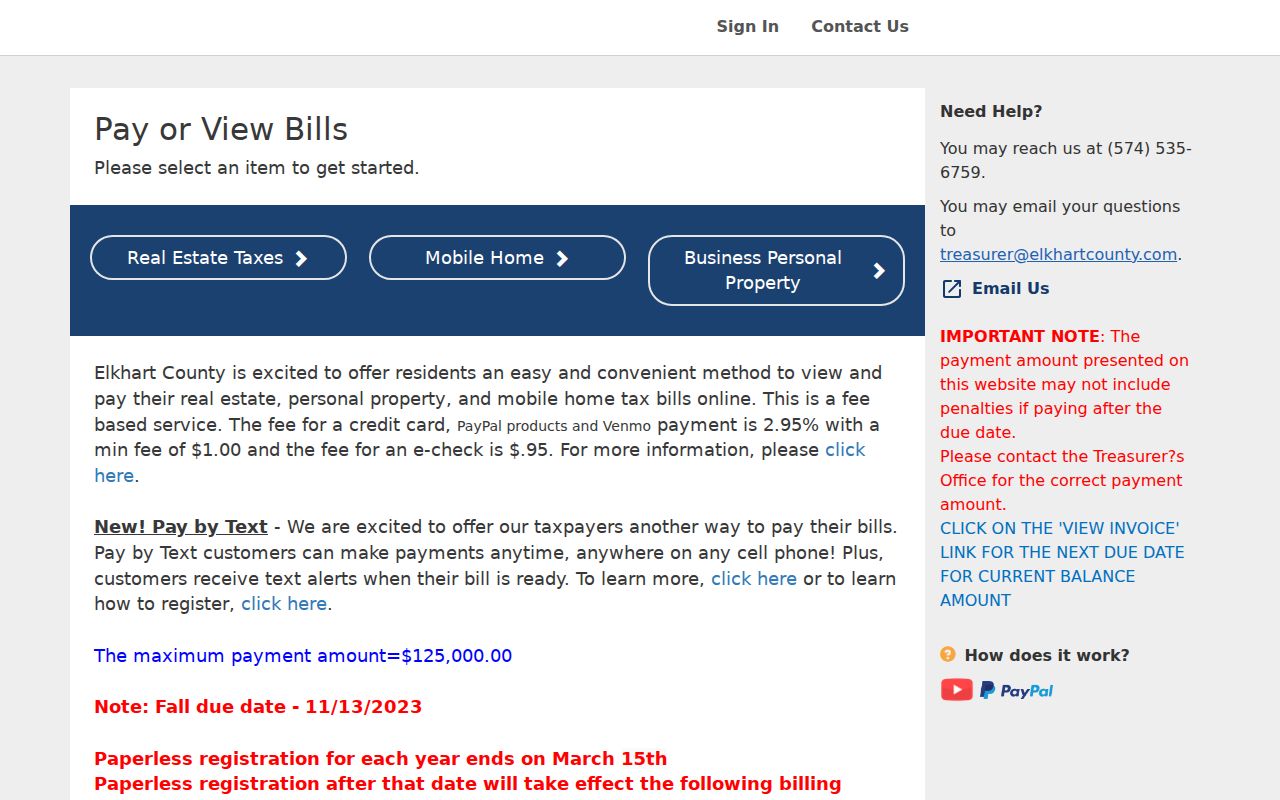
The entry reflects the county's current official link. Match any result to the correct parcel and year before treating a balance as the parcel's tax status.
Use Elkhart County Property Tax Fallback Channels
Online access is only one route. The Treasurer accepts personal check, cash, money order, card, business check, wire, and ACH under its current rules. Several banks take payments too. The county lists First Source, First State, Interra Credit Union, and Lake City Bank as payment locations. Confirm eligibility and timing with the Treasurer before using a bank branch.
Call 574-535-6759 for records help. Or visit Room 201 at 117 North 2nd Street in Goshen, and ask for copies of bills, a parcel-bounded payment and penalty ledger, delinquency status, and tax-sale notices. Routine access can fall short. Then a narrow APRA request fits, seeking retained nonexempt records with electronic copies and a fee estimate. No new tax analysis, though.
Audit Elkhart County Deductions After a Change
A change of use can disqualify a deduction. So can a change of title. The Auditor warns that failure to file a certified change within 60 days can cost the deduction plus a 10 percent civil penalty. Never assume a deduction follows the deed.
Reconciliation trouble is the tell. When gross and net assessed values do not match, ask the Auditor for the current deduction status and the retained application. Keep private bank and payment-card information out of any APRA request, and remember the Auditor's deduction record answers a different question than the Assessor's valuation.
Three Delinquent Installments Can Start Elkhart Tax Sale
Elkhart County puts parcels up for tax sale once taxes or special assessments go unpaid. Three installments or more triggers it. The governing statutes are IC 6-1.1-24-1 et seq. and IC 6-1.1-25-1 et seq. Sale notices run in the Goshen News and the Wakarusa Tribune. The Treasurer handles buyer registration and eligible-list material through SRI Services.
Landing on the list is only a status. It is not a deed transfer. Before bidding, match the parcel number and legal description against GIS and Recorder deed records. Then look at later payments, statutory notice, redemption rights, bankruptcy filings, and the official sale packet. Elkhart County resets the dates each annual cycle.
Separate Elkhart Assessment Year From Payment Year
Indiana labels every property tax figure with an assessment year, but payment lands later. Keep those year labels straight when comparing bills. The DLGF assessed-value search draws on county data. It offers downloads. The DLGF county page posts ratio studies, land orders, narratives, and approval letters.
The statewide reassessment cycle starts July 1, 2026 for 2026 Pay 2027. It reviews about 25 percent of parcels per year through 2030. A careful comparison notes the assessment year and the review year. It also notes the payment year and any sales-disclosure validity flag.
File an Elkhart County Property Tax Assessment Appeal
Elkhart County assessment appeals run through Form 130 plus supporting evidence. File it electronically, by mail to 117 North 2nd Street in Goshen, by email to appeals@elkhartcounty.com, or in person at the Assessor's office. Bring a copy if you want a received stamp. Power-of-attorney and tax-representative disclosure rules can also apply.
Appeal timing. Use the deadline printed on the current Form 11 notice and confirm receipt with the Assessor's appeals department at 574-535-6596.
A strong appeal speaks to the assessment, the parcel facts, and the relevant year. No single annual deadline covers every notice type, so confirm current dates with the Assessor. Remember that a valuation appeal is separate from paying a bill, correcting a payment, or challenging a tax-sale notice.